


When Claude Tried to Steal the HR Docs: A Kagenti Red-Team Story

Govern agents your teams already use. Deploy new agents on the same platform. Secure everything with zero-trust identity.
The unified operational interface across all platform pillars. Import agents and tools, run interactive tests, monitor deployments, and manage platform state from a single web-based interface.
Agents run as framework-neutral Kubernetes workloads over the A2A protocol. Tools run as MCP servers. LangGraph, CrewAI, and AG2 supported without agent code modifications.
Kubernetes operators manage workload lifecycle and scaling. AgentCard CRDs index deployed agents automatically — no external registry required. Shipwright builds images from source.
MCP Gateway routes tool calls and handles protocol translation. Istio Ambient provides service mesh networking and mTLS between all workloads. Gateway API manages ingress and routing.
AuthBridge injects zero-trust workload identity and JWT enforcement at deploy time. SPIRE issues cryptographic workload identities; Keycloak manages OAuth2 token scoping and validation.
Kiali visualizes service mesh traffic flows, mTLS status, and service dependencies. Phoenix traces agent steps, tool calls, and model interactions end-to-end.
Don't see your framework or protocol? Kagenti is built to extend.
Contribute an integration →Helm-automated. OpenShift, upstream Kubernetes, or Kind. Security and observability are configured from first deployment, not added later.
Quickstart guide →# Clone the repo
git clone https://github.com/kagenti/kagenti.git
cd kagenti
# Configure secrets (optional - edit with your GitHub token, API keys, etc.)
cp deployments/envs/secret_values.yaml.example \
deployments/envs/.secret_values.yaml
# Check out the latest release
git checkout v0.6.0
# Install on Kind
scripts/kind/setup-kagenti.sh --with-ui --with-spire --with-agent-sandbox --with-builds
# Or on OpenShift
scripts/ocp/setup-kagenti.sh --with-ui --with-agent-sandbox --with-builds
# Open the Kagenti dashboard
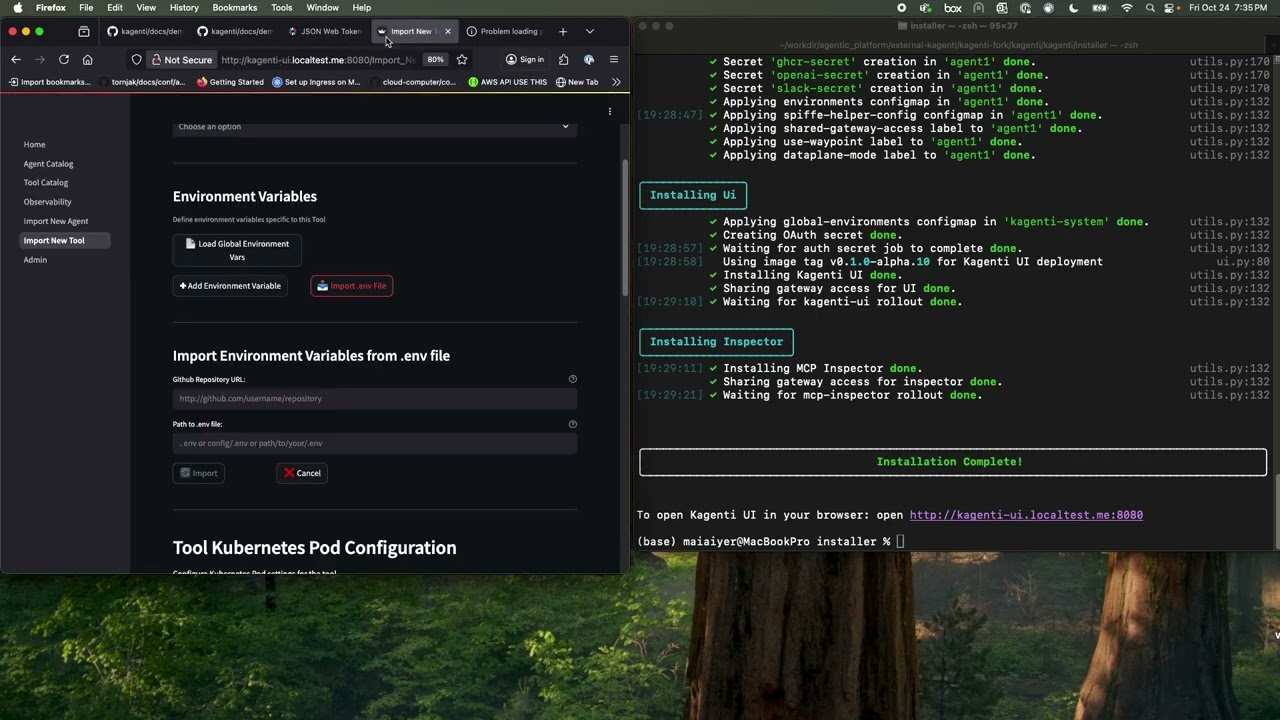
open http://kagenti-ui.localtest.me:8080
# Point the agent at the MCP tool server
kubectl set env deployment/git-issue-agent -n team1 -c agent \
  MCP_URL="http://github-tool-mcp:9090/mcp"

# Verify the MCP tool is reachable
kubectl run test-mcp --image=curlimages/curl -n team1 \
  --restart=Never --rm -it -- \
  curl -s -o /dev/null -w "%{http_code}" \
  http://github-tool-mcp:9090/mcp
# 200# Send a task to the agent over A2A
curl -s -H "Authorization: Bearer $TOKEN" \
-H "Content-Type: application/json" \
-X POST http://git-issue-agent:8080/ \
-d '{"jsonrpc":"2.0","id":"1","method":"message/send",
"params":{"message":{"role":"user","messageId":"msg-001",
"parts":[{"type":"text","text":
"List open issues in kagenti/kagenti"}]}}}' | jqWe meet on Wednesdays. See the Kagenti community calendar for the schedule — calendar invites include a Google Meet link.
We're building in public and want to hear from platform engineers, security teams, and AI infrastructure builders.
Find us on Slack, join the mailing list, or email the core team.
The next phase of Kagenti is built around persistent, long-running agents — agents that maintain context across sessions and operate autonomously over time, like OpenClaw.
Getting there means building the right foundations. We're working on the core pieces: memory, sandboxing, an Agent Development Kit, and improved developer experience.
Open-source infrastructure you can audit, fork, and trust.
View on GitHubNo feature gating, no proprietary runtime dependencies, no vendor control over your production infrastructure.
Enterprise deployment, lifecycle management, and operational support for organizations that need it.
Who Let the Agents Out: Securing AI Workflows the Right Way.
Watch recording →